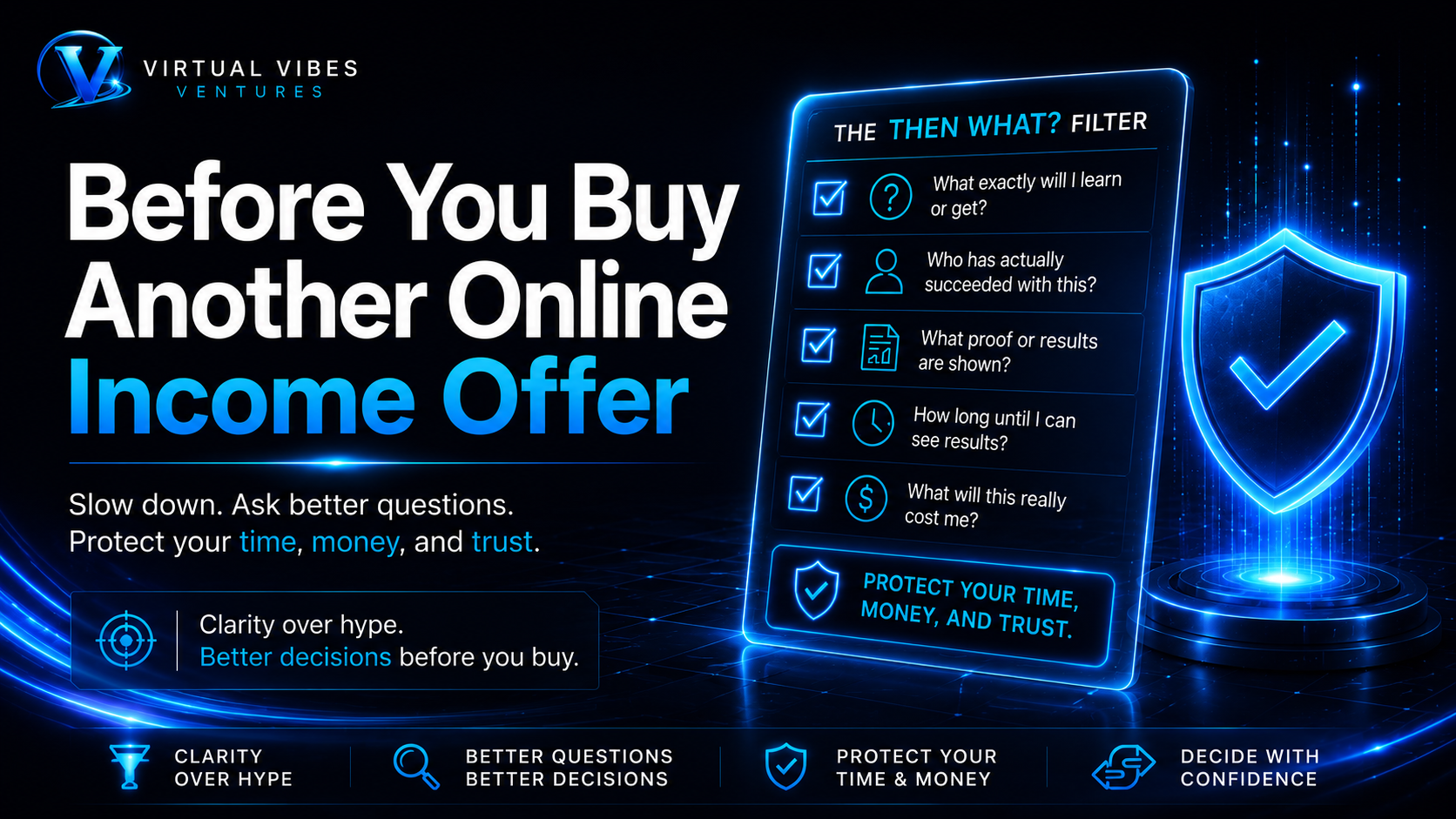
Online income offers are everywhere—courses, AI tools, side-hustle systems, affiliate programs, digital products, automation platforms, and “done-for-you” promises. Some may be useful. Some may not.
Before you buy, do not ask only whether it worked for someone else or whether the sales page looks convincing. Ask what happens after you pay. What will you have to do, learn, spend, build, and maintain?
That is the purpose of the Then What? question: to look beyond the dream and examine the actual process.
A Good Sales Page Can Still Leave Out Important Details
A sales page is designed to capture your attention and make an offer feel valuable. That does not automatically make it dishonest, and marketing is not always manipulation. But a persuasive sales page is not the same thing as a complete explanation of what you are buying.
A sales page may show income screenshots, happy customers, fast results, bonuses, urgency, and success stories. What it may not explain clearly is how much work is involved, what skills you need, what additional costs may appear, what happens if you get stuck, how long the process takes, and whether the seller earns more from using the method or selling it.
Do not stop at the headline. Slow down and ask for the details the sales page leaves out.
“Then What?” Is a Protection Question
“Then What?” is not a negative question. It is not about fear or rejecting every opportunity. It is a protection question designed to help you protect your time, money, energy, and trust before you commit.
When you ask “Then What?” you force the offer to explain what happens after the promise.
For example, an AI tool may write content for you—but where will you publish it, who is the audience, how will the content create traffic, how will that traffic build trust, and how will trust lead to sales? You also need to know whether the content is accurate and what happens when everyone uses similar tools.
A course may promise to teach you how to make money with digital products—but you still need to decide what product to create, who it is for, what problem it solves, how to confirm people want it, where to sell it, how to attract buyers, how to handle refunds, and what to change if nobody buys.
“Then What?” exposes the gap between the promise and the process—the exact gap where beginners often lose time and money.
Beginners Do Not Need More Hype. They Need More Clarity.
A beginner does not need another shiny promise. A beginner needs plain English, realistic expectations, clear steps, honest timelines, and warnings before expensive mistakes happen.
Virtual Vibes Ventures is not built to claim that every online income idea is fake. People do make money through services, content, software, affiliate marketing, courses, digital products, communities, coaching, ecommerce, and AI tools.
But buying the tool, course, or system is rarely the whole process. You still need a real problem to solve, an audience, trust, traffic, a clear offer, and the ability to follow through.
The Tool Is Not the Business
One of the biggest mistakes people make online is confusing the tool with the business. A tool can help you write, design, organize, automate, or build—but it does not automatically create demand, trust, traffic, buyers, or a useful offer.
The business is the problem you solve, the people you help, the trust you build, and the value you deliver. That is why Virtual Vibes Ventures follows a simple principle: tool last, problem first.
Before you buy the tool, understand the problem. Before you build the product, understand the person. Before you chase the income, understand the process.
Ask These Questions Before You Buy
Before you buy any online income offer, make sure you can answer a few basic questions clearly. What exactly are you buying? What problem does it solve? What skills, tools, subscriptions, advertising, or services will you still need? What work will you have to do after the purchase? Are the results typical, is support available, and is there a refund policy?
Then ask one final question: Can you explain the offer in plain English to someone else? If you cannot, you may not understand it well enough yet. That does not mean you should never buy it. It means you should slow down before you commit.
Simple Does Not Always Mean Easy
Many online offers use the word simple. Simple steps. Simple systems. Simple formulas. But simple does not always mean easy.
The basic path may be easy to describe: find a problem, create something useful, put it in front of the right people, build trust, make an offer, and improve based on feedback.
The challenge is that every one of those steps has details, skills, decisions, and work behind it. A process can be simple to explain without being effortless to execute.
That is where beginners need help. Not hype. Help.
“Done For You” Still Requires Understanding
“Done for you” can sound like the hard part has already been handled. But you still need to understand who the offer is for, what strategy it uses, where the traffic comes from, what proof supports it, and what follow-up is required.
A done-for-you funnel still needs traffic. A website still needs trust. A product still needs buyers. An AI system still needs supervision.
If you do not understand how the system works, you may own something you cannot operate. That is not freedom. That is confusion with a receipt.
Screenshots Are Not a Business Plan
Income screenshots can be powerful, but they can also be misleading. A screenshot may show that money came in without showing how much was spent, how long it took, how many attempts failed first, whether refunds happened later, whether ads were used, whether an audience already existed, or whether the person had years of experience.
A screenshot can be a clue, but it should not be the whole reason you buy. You need more than proof that something happened. You need to understand the process, costs, timeline, risks, and what you would have to do next.
The Real Goal Is Not Chasing Hype
The real goal is not to chase every new trend. It is to build durable relevance by learning skills and principles that still matter when tools, platforms, algorithms, and AI change.
Trust, clarity, usefulness, consistency, problem-solving, proof, communication, follow-through, and understanding the customer will keep mattering.
That is why Virtual Vibes Ventures focuses on structure over hype. Hype fades. Structure helps you think, decide, and build.
What To Do Before You Buy Another Online Income Offer
Before you buy, write down the offer and answer these seven questions:
- What is the promise? State it in one sentence.
- What is the process? Explain what you will actually do after buying.
- What is missing? Identify anything the sales page does not explain clearly.
- What will it cost after the first payment? Include tools, ads, subscriptions, upgrades, hosting, software, and time.
- What skills do you need first? Consider writing, design, sales, technology, research, video, email marketing, or audience building.
- What happens if you get stuck? Look for support, training, examples, updates, or a community.
- What is the next action you must take immediately after buying?
If you cannot answer these questions, pause. The offer may still be useful, but you need clarity before commitment.
A Better Way Forward
Virtual Vibes Ventures exists to help people make clearer online decisions—not to shame anyone for wanting a better life, mock beginners for being confused, or pretend online income is impossible.
The goal is to help people slow down, ask better questions, understand what they are buying, avoid expensive mistakes, and move forward with more clarity.
You do not need to know everything, buy every tool, or chase every trend. You need a clear way to evaluate what deserves your time, money, and trust.
Before you buy another online income promise, slow down and ask what happens next. That one question may save you money, time, and frustration—and help you separate a useful opportunity from noise.
Not Sure What You Could Sell Online?
Get the free What Can I Sell Online? guide for beginner-friendly ideas, clearer next steps, and practical questions to help you choose an offer that fits your skills and experience.
Enter your email, get the guide, and start building with more clarity.


