If you’ve ever wanted to build an online business, you’ve probably experienced the same cycle that traps thousands of people every day. You find an interesting idea, begin researching it, watch a few videos, compare different tools, read reviews, bookmark websites, and convince yourself that you’re making progress. By the end of the day, you may have learned a great deal, yet nothing in your life has actually changed. The business still hasn’t been started, the productSomething created for another person to use, buy, download, access, or experience. It may be digital, physical, or servi… still hasn’t been created, and no customer has been served.
Learning is valuable, but learning alone doesn’t create momentum. At some point, every entrepreneur reaches a moment where information has taken them as far as it can. The only thing left to do is take the next reasonable step. That simple idea became one of the core doctrines behind Virtual Vibes Ventures:
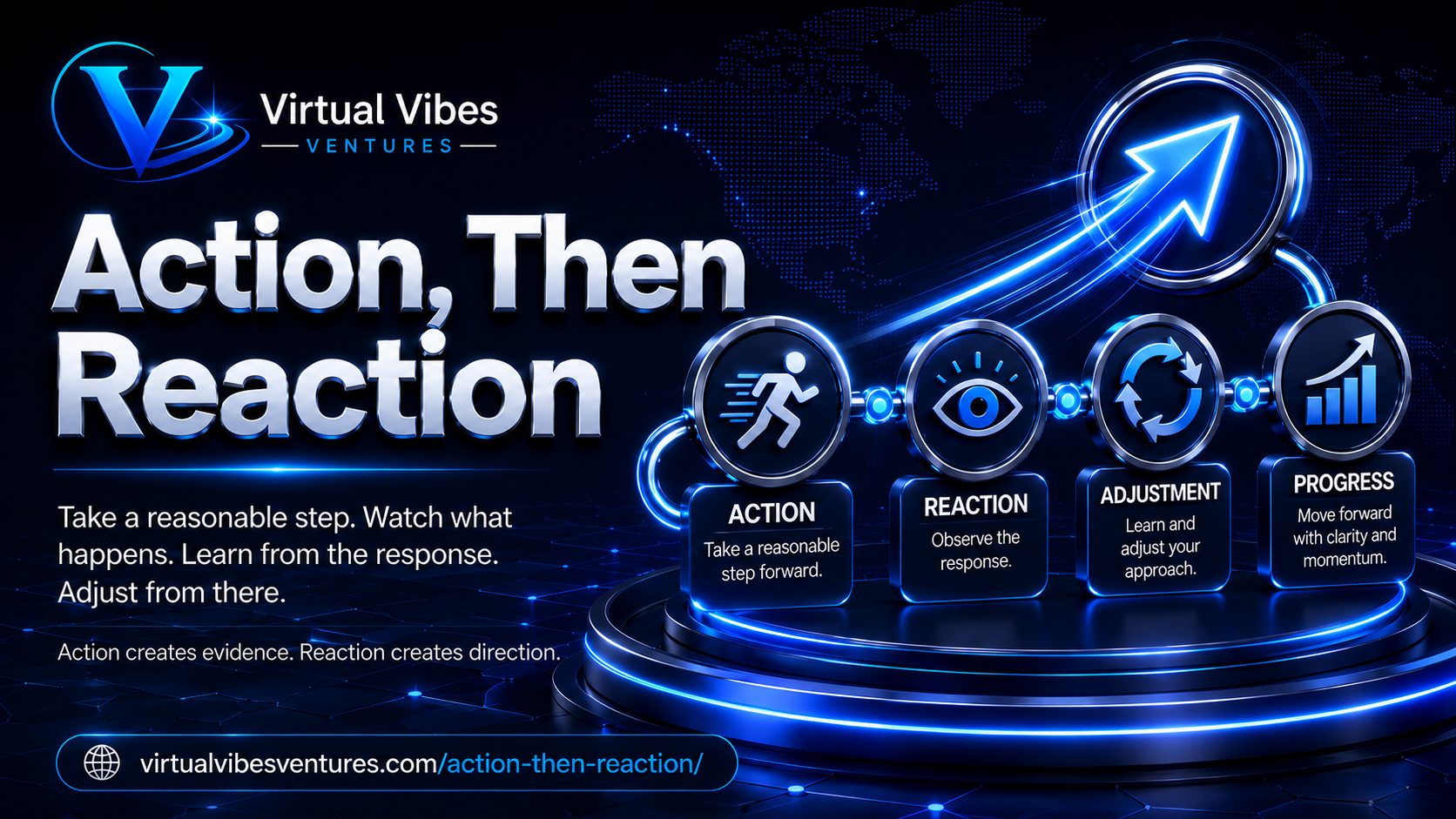
Action. Then reaction.
The order matters.
Most people want the reaction before they’re willing to take the action. They want proofEvidence that supports a claim, such as verifiable results, transparent demonstrations, credible data, or independent re… More that an idea will work before investing their time. They want confidence before publishing their first article, certainty before launching their first productSomething created for another person to use, buy, download, access, or experience. It may be digital, physical, or servi…, and guarantees before taking the first step. Unfortunately, business doesn’t usually work that way. Most of the answers people are searching for don’t appear until after they’ve done something that produces a response.
That’s why action comes first.
Why Information Eventually Stops Helping
There is nothing wrong with research. In fact, one of the biggest themes throughout Virtual Vibes Ventures is learning to ask better questions before making decisions. You should compare products, investigate opportunities, understand pricing, and look for evidence before spending your money. Those habits will save you from countless mistakes.
The problem begins when research quietly becomes a substitute for building.
It’s easy to spend another evening watching YouTube because it feels productive. It’s easy to compare another AI tool because it feels like you’re getting closer to the answer. It’s easy to buy another course because you believe one more expert might finally explain everything in a way that makes success inevitable.
The uncomfortable truth is that no amount of preparation can completely replace experience. Reading about building a business is not the same as building one. Watching someone else publish products isn’t the same as publishing your own. Eventually, every builderSomeone who creates, improves, organizes, or explains something useful for another person. A builder adds original value… More reaches a point where another hour of research produces less value than one hour of actual work.
That isn’t because learning stops being important. It’s because experience begins teaching lessons that information never could.
Every Action Creates New Information
One of the biggest reasons people hesitate is because they believe making the wrong decision is worse than making no decision at all. In reality, doing nothing usually teaches you nothing.
Imagine you publish your first article.
Maybe no one reads it.
That feels disappointing, but now you have information. You can improve the headline, strengthen the introduction, rewrite the images, or promote it differently.
Imagine you create your first digital productA digital product is something created, sold, and delivered electronically rather than shipped as a physical item. Commo… More.
Perhaps it doesn’t sell.
Again, you’ve learned something valuable. Maybe the problem wasn’t the productSomething created for another person to use, buy, download, access, or experience. It may be digital, physical, or servi…. Maybe it was the audience, the pricing, the title, the description, or the way you presented it.
Imagine you launch a websiteA collection of connected pages and resources published under a domain name. A business website may include content, nav….
Visitors spend time on one page but ignore another. That isn’t failure either. It’s feedback. The behavior of real people begins showing you where their attention naturally goes, and that information becomes far more valuable than another evening spent wondering what might happen.
Nothing teaches faster than reality.
That’s why action matters. Every meaningful action creates a reaction, and every reaction gives you information you didn’t have before.
The Difference Between Guessing and Learning
Many beginners believe experienced entrepreneurs simply know what works.
They don’t.
Experienced builders test ideas. They pay attention to what happens. They adjust. Then they test again.
Instead of guessing what customers want, they ask. Instead of assuming a productSomething created for another person to use, buy, download, access, or experience. It may be digital, physical, or servi… is perfect, they improve it. Instead of expecting every decision to succeed immediately, they recognize that every attempt produces useful information, even when the outcome isn’t what they hoped for.
That mindset changes everything.
Failure stops looking like proofEvidence that supports a claim, such as verifiable results, transparent demonstrations, credible data, or independent re… More that you’re incapable. It starts looking like data you can use to make the next decision a little better than the last one.
Over time, those small adjustments compound. One improvement leads to another. One lesson prevents the next mistake. One successful decision creates the confidence to make another.
That is how businesses grow. Not through perfect decisions, but through continuous learning driven by action.
Why This Does Not Mean “Just Take Action”
Action, Then Reaction is not an excuse to act recklessly. It does not mean buying every AI tool you see, jumping into every business opportunity, or believing every sales page that promises financial freedom. Blind action can waste just as much time and money as endless overthinking, which is why this doctrine must work alongside the other principles behind Virtual Vibes Ventures.
Before taking action, ask better questions, slow down when necessary, look for evidenceInformation that can be checked, compared, and evaluated. Screenshots, testimonials, data, and claims may contribute evi… More instead of hype, read the fine printDetails such as limitations, exclusions, renewal terms, refund rules, fees, and responsibilities that may be less promin… More, and understand the real problem you are trying to solve. Once you have done enough research to make a reasonable decision, stop waiting for perfect certainty and take the next step. Most people do not need every answer before they begin; they need enough information to move forward responsibly and learn from what happens next.
Learn From the Reaction
Every article you publish, productSomething created for another person to use, buy, download, access, or experience. It may be digital, physical, or servi… you create, video you upload, and offerThe complete reason someone may choose to buy, join, subscribe, or download. It combines the problem, outcome, product, … More you make produces some type of response. Sometimes that response is encouraging, and sometimes it is disappointing, but neither outcome should be ignored. Instead of asking only whether something succeeded or failed, ask what the result taught you.
Did people click the headline but leave the page quickly? Did they stay and read the entire article, subscribe, ask questions, or misunderstand part of your message? Did one section attract more attention than everything else? Those reactions replace assumptions with evidenceInformation that can be checked, compared, and evaluated. Screenshots, testimonials, data, and claims may contribute evi… More and help you make better decisions instead of repeating the same guesses.
Business becomes less intimidating when you stop treating every outcome as a final judgment and begin treating it as useful feedback. A weak response does not automatically mean the idea is worthless, just as one strong response does not prove that everything is perfect. The reaction gives you information, and that information helps you decide what to keep, change, test, or remove.
Small Adjustments Create Big Results
Most successful businesses are not built through one brilliant decision. They are built through hundreds of small improvements made over months and years. A better headline may increase clicks, a clearer productSomething created for another person to use, buy, download, access, or experience. It may be digital, physical, or servi… description may improve understanding, and a stronger image may attract more attention. A revised sales page may answer questions buyers were already asking, while a useful email may build more trust than the one sent before it.
Each improvement may seem small on its own, but together they create momentum. Progress rarely happens because everything was perfect the first time. It happens because someone cared enough to keep learning, adjusting, and building after the first attempt.
That is why Action, Then Reaction is so useful. It gives you permission to improve instead of expecting perfection, and it helps you treat progress as a process rather than a single make-or-break decision.
Build Evidence, Not Assumptions
One of the goals of Virtual Vibes Ventures is to help people stop making decisions based entirely on emotion, hype, or guesswork. Instead of wondering whether an idea might work, test it. Instead of assuming people want a productSomething created for another person to use, buy, download, access, or experience. It may be digital, physical, or servi…, ask them. Instead of believing every marketing claim, investigate it. Instead of chasing another promise, build something and observe what actually happens.
Over time, those observations become evidenceInformation that can be checked, compared, and evaluated. Screenshots, testimonials, data, and claims may contribute evi… More, and evidenceInformation that can be checked, compared, and evaluated. Screenshots, testimonials, data, and claims may contribute evi… More builds confidence more effectively than wishful thinking ever will. The more evidenceInformation that can be checked, compared, and evaluated. Screenshots, testimonials, data, and claims may contribute evi… More you collect, the less you have to rely on assumptions. You begin making decisions based on what real people do, what customers ask, what content attracts attention, and what offers produce a response.
That is one of the biggest differences between building and merely dreaming. Dreaming creates possibilities, but action produces information that can be used to improve the next decision.
Final Thought
Every successful business begins with a first step, but that step will not answer every question, remove every uncertainty, or guarantee every outcome. What it will do is begin producing information you can use to make the next decision with greater confidence.
Thinking, planning, and research all have value, but eventually progress depends on movement. Take the next reasonable step, pay attention to the response, learn from what happens, make the necessary adjustment, and continue building. That is how confidence, experience, and clarity grow over time.
Action creates evidenceInformation that can be checked, compared, and evaluated. Screenshots, testimonials, data, and claims may contribute evi… More. Reaction creates direction. Adjustment creates progress.
Continue Your Journey
These related Virtual Vibes Ventures resources build on the same ideas:
- Thinking About It Is Not the Same As Building It — Learn why action creates opportunities that thinking alone never can.
- There Has To Be A Better Way — Explore why clarity often matters more than motivation.
- The Then What? Filter — Ask what happens after the promise, purchase, or first step.
- Show Me the Evidence — Build decisions on facts instead of marketing claims.
- Entrepreneurship: Where Do I Begin? — Start with the problem before chasing the productSomething created for another person to use, buy, download, access, or experience. It may be digital, physical, or servi….
Each resource is designed to help beginners replace confusion with clarity, hype with evidenceInformation that can be checked, compared, and evaluated. Screenshots, testimonials, data, and claims may contribute evi… More, and hesitation with meaningful action.
Get the Free Guide
Download the free What Can I Sell Online? guide for beginner-friendly ideas, practical questions, and clearer next steps that can help you identify an online income direction suited to your skills, interests, and experience.
Subscribing also keeps you informed when Virtual Vibes Ventures publishes new Featured Series, Beginner Roadmap articles, BuilderSomeone who creates, improves, organizes, or explains something useful for another person. A builder adds original value… More Mindset content, AI Tool Reality Checks, Opportunity Reviews, free guides, and downloadable resources.
You do not need every answer before you begin. You need enough clarity to take the next reasonable step, enough awareness to study the reaction, and enough patience to improve what you build.
Build with clarity. Learn from evidenceInformation that can be checked, compared, and evaluated. Screenshots, testimonials, data, and claims may contribute evi… More. Keep moving forward.